Your Pentester Costs $200/hr. This One Costs $1.50/Day.
Automated AI pentesting runs recon, exploits, and reports 24/7 — for less than your morning coffee.

Your penetration tester charges $200 an hour. Works business hours. Takes vacation. Juggles four other clients.
Now picture this: an agent that runs recon at 2 AM, scans for fresh CVEs while you sleep, verifies exploits before your morning coffee, and drops a clean report on your desk by 8 AM. Every single night. For $1.50 a day.
That's not a pitch. That's the math on automated AI penetration testing.
What does a "pentester on call" actually mean?
Traditional penetration testing is an event. You schedule it weeks in advance. A team shows up, runs their tests over days or weeks, delivers a report. Then they leave — and your security posture starts decaying the moment they walk out the door.
A pentester on call means the capability stays. You run tests when you want — after a deployment, before an audit, on a Tuesday night because you pushed a new API endpoint. No scheduling. No contracts. No minimums.
48,174 CVEs were published in 2025 (NVD). That's 131 new potential vulnerabilities per day. An annual pentest catches what existed on the day it ran. A continuous tool catches what exists right now.
How much does traditional pentesting really cost?
Here are the real numbers most vendors don't put on their homepage.
A certified penetration tester charges $150 to $300 per hour. A standard web application test takes 40 to 80 hours. That's $6,000 to $24,000 for a single engagement.
Add project management, scoping calls, report writing, and remediation support. A mid-range engagement easily reaches $15,000 to $25,000.
Need quarterly testing? Multiply by four: $60,000 to $100,000 per year.
Most companies test once annually — not because that's sufficient, but because it's all the budget allows. 60% of breaches exploit known, already-patched vulnerabilities (Verizon DBIR 2025). The gap between annual tests is exactly where those breaches happen.
What does $1.50 a day buy you?
Redcell's Basic plan costs $47 a month — that's $1.57 per day. Here's what runs while you sleep.
- Reconnaissance. Automated subdomain discovery, port scanning, service fingerprinting, and technology stack identification across your entire scope. The same recon phase that takes a human tester 8 to 16 hours runs in minutes.
- CVE scanning. Every discovered service gets checked against current vulnerability databases using Nuclei templates — the same engine security researchers use to publish new vulnerability checks daily.
- Exploit verification. Not just "this might be vulnerable." Proof-of-concept testing confirms which findings are actually exploitable. This step kills false positives and saves your dev team from chasing ghosts.
- Report generation. Results export to Markdown, JSON, PDF, or SARIF. Push them straight to Jira, GitHub Issues, or your compliance workflow.
- Scope guard. Authorization controls prevent testing anything outside your defined boundaries. Every scan stays legal and contained.
Disclosure: We build Redcell.
"But can AI replace a human pentester?"
Wrong question. The right question: can AI replace the pentesting you're not doing?
Most organizations test once a year. Some don't test at all. The barrier has never been desire — it's cost and access. At $15,000 per engagement, continuous testing is a fantasy for most teams.
Automated AI pentesting doesn't replace your annual deep-dive with a senior red teamer. It fills the 364 days between deep-dives with continuous coverage.
| Feature | Human pentester | AI pentesting agent |
|---|---|---|
| Strength | Deep, creative, finds chained exploits | Broad, fast, covers full scope |
| Cost | $15,000+ per engagement | $47/month for unlimited scans |
| Availability | 4–6 weeks after booking | Right now |
| Coverage | What existed on test day | What exists today |
| Frequency | Annual or quarterly | On every deployment |
The best security programs use both. But if you're testing once a year — or not at all — automated coverage is the 10x improvement that changes the equation.
FAQ
How long does an automated pentest take?
Depends on scope. A single web application with a handful of subdomains typically completes in under an hour. A larger network with hundreds of services may take several hours. Either way, results arrive the same day — not two weeks later.
Is this just a vulnerability scanner with a better name?
No. Vulnerability scanners flag potential issues. Automated AI pentesting goes further: it performs reconnaissance to discover your full attack surface, scans for known CVEs, then attempts proof-of-concept exploitation to verify which vulnerabilities are actually exploitable. That verification step is what separates a scanner from a pentest.
Do I need security expertise to use it?
You need basic command-line comfort. Install with one command, define your targets, and run. Reports are structured and readable — you don't need a CISSP to understand what needs fixing.
Own the capability. Don't rent the consultant.
A human pentester costs $200 an hour and works 40 hours a week. An AI pentesting agent costs $1.50 a day and works 168 hours a week.
This isn't about replacing human expertise. It's about making sure your security testing actually happens — continuously, automatically, on every change — instead of once a year when the budget allows it.
Start tonight:
curl -fsSL [https://redcell.sh/install.sh](https://redcell.sh/install.sh) | sh
Put AI defensive automation into your terminal
RedCell gives defensive engineers autonomous reconnaissance, CVE verification, and triage reports with strict scope guard.
Read next

Skip the $15k Pentest — Run One Tonight for $47
Your last penetration test cost $15,000. It took six weeks to schedule, two weeks to execute, and by the time the 80-page PDF hit your inbox, three new CVEs had already dropped against your stack. That's the dirty secret of traditional pentesting. You're paying for a snapshot that's already stale. Here's the alternative: install a CLI tool, define your scope, and have a full penetration test running before midnight. Total cost: $47 a month.
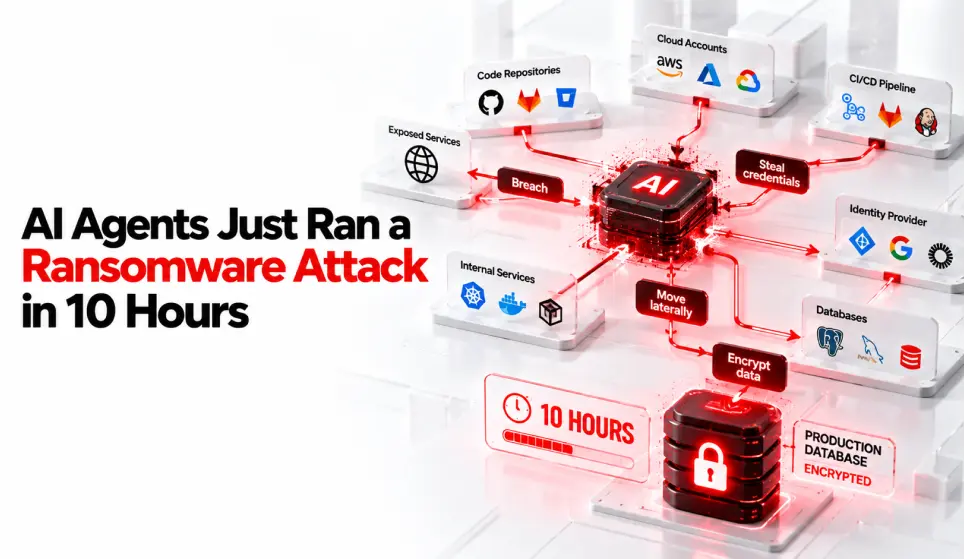
AI Agents Just Ran a Ransomware Attack in 10 Hours
An AI agent completed a full ransomware attack in under 10 hours — no human operator needed. Here's what happened and how to test whether your defenses can keep up.
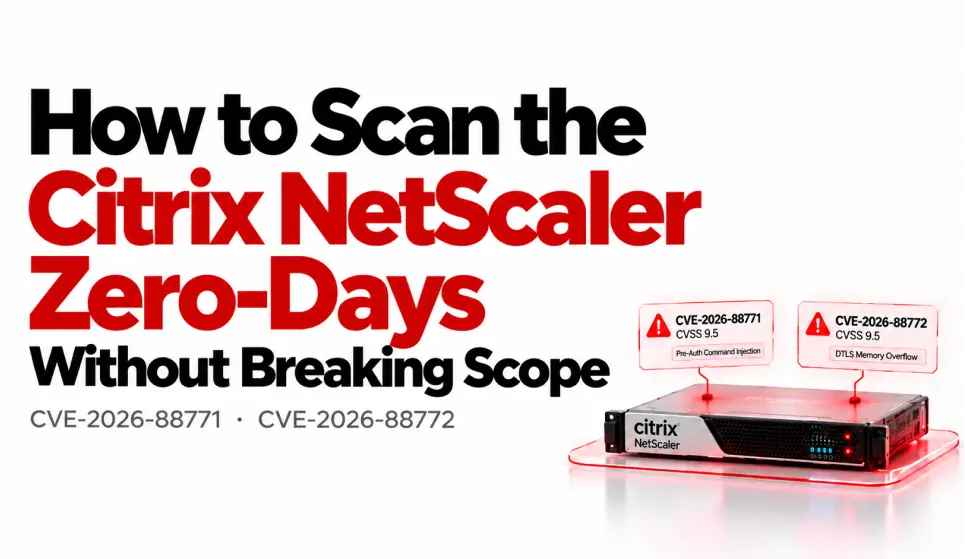
How to Scan the Citrix NetScaler Zero-Days Without Breaking Scope
CVE-2026-88771 and CVE-2026-88772 hit 22,000 exposed NetScaler instances. Learn how to map, scan, and verify both zero-days inside strict scope using an AI pentesting agent.